
2 Nov
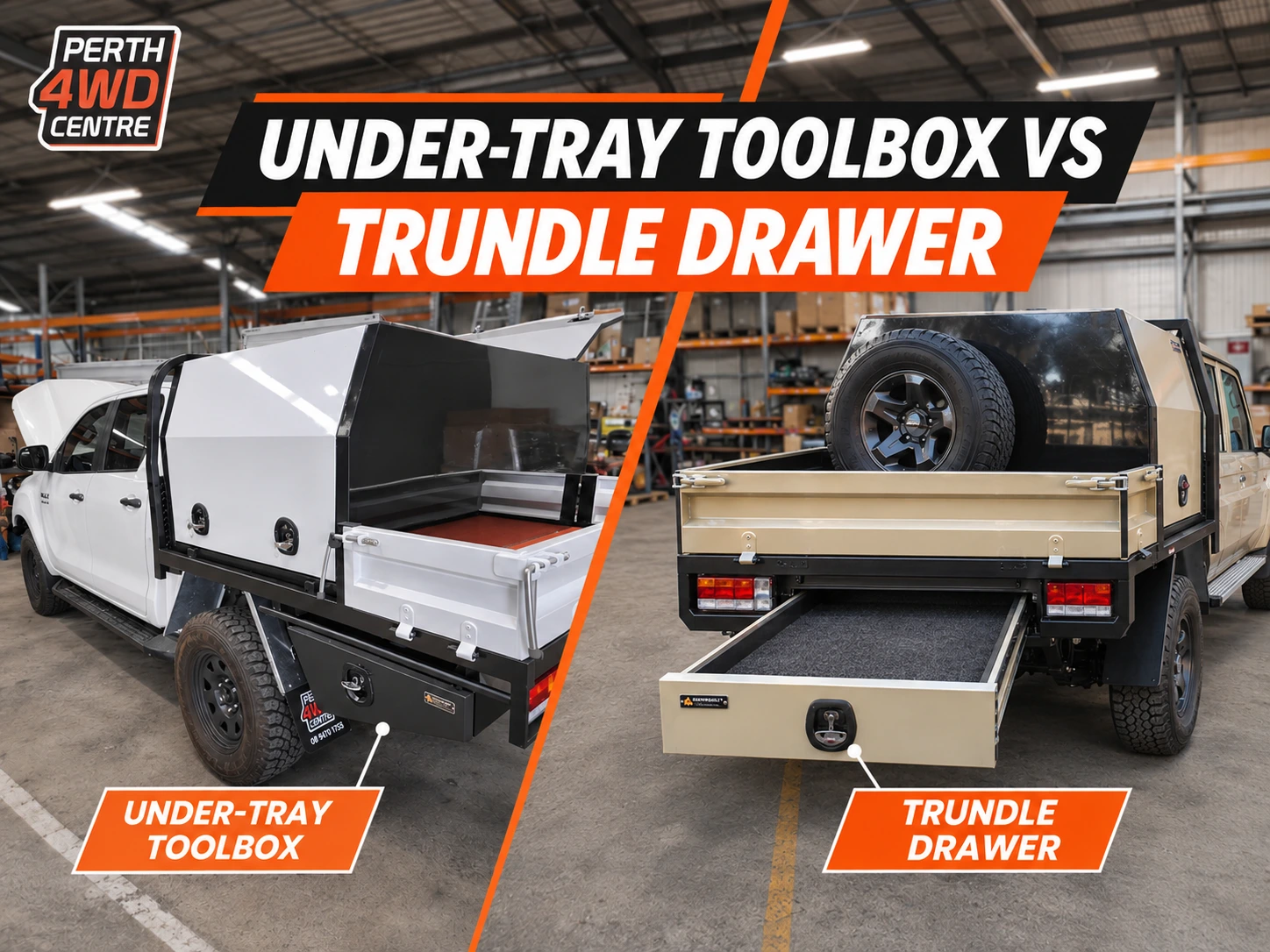
Ever backed into a tight carport, then realised you can’t open the box holding the one tool you need? That’s exactly the headache this decision can save you.
In this, we are going to compare both the under-tray toolbox and the trundle drawer. A side-opening under-tray toolbox suits small, sorted gear you grab all day. A rear trundle drawer suits long or heavy gear you’d rather slide out than dig for. Let us understand both the options in detail.
Under-Tray Toolbox vs Trundle Drawer at a Glance
A toolbox opens from the side and gives you tall, boxy storage. A trundle drawer slides out the rear and gives you long, shallow, low-profile storage.
This table puts real spec sheet figures side by side. So, let’s have a look.
| Factor | Under-Tray Toolbox | Trundle Drawer |
|---|---|---|
| Access direction | Side of the ute, in front of or behind the rear wheel | Rear of the ute, sliding out on runners |
| Usable shape | Tall and narrow. One tapered 900 mm pair shrinks from 450 mm tall at the top to 290 mm at the bottom | Long, flat and shallow. Listed models run roughly 125 to 240 mm tall outside |
| Opening space needed | Room beside the ute for the door or lid | A full drawer length behind the ute, plus room to stand |
| Empty weight | One underbody box is listed at 14.5 kg | One steel drawer range is listed at 79.5 kg (1,500 mm) and 87 kg (1,700 mm) |
| Load rating | Not always published, so ask before buying | Listed models range from 80 kg to 227 kg |
| Storage layout | Separate boxes, often sold in pairs | One long sliding compartment |
| Towing | Stays usable with a trailer hitched | Can be blocked by a trailer or towbar accessory |
Ratings and weights vary by model, so always check the spec sheet for the exact unit.
If you want real numbers for your own ute, you can get a quote on a tray with under-tray storage, and we’ll guide you through multiple sizes and options.
When an Under-Tray Toolbox Suits Your Ute
If your day involves grabbing small things over and over, a side access ute toolbox is the better fit. It mounts beside the chassis rails and opens at knee or hip height, so there’s no climbing onto the tray deck.
They shine for:
- Hand tools and power tool batteries you use all day
- Tie-down straps, ratchet straps and shackles that tangle in an open tray
- Recovery gear like a snatch strap and tyre deflator
- First aid kits, fuses, gloves and spare parts
Running a pair on either side lets you split gear by job. Electrical on the left, plumbing on the right, and you’ll never play lucky dip again.
Door Style and Materials
A drop-down door opens flat and can double as a small shelf for parts. A lift-up lid stays out of your way but needs headroom under the tray edge.
Most boxes come in aluminium checker plate, flat plate or powder-coated steel, with listed plate thickness around 1.5 to 2.5 mm. Aluminium saves weight and won’t rust. Steel takes knocks well but adds kilos, so lighter aluminium toolboxes make sense if you plan to run more than one.
The catch with any toolbox? Anything pushed to the back of a deep box is a pain to reach.
When a Trundle Drawer Suits Your Ute
If your gear is long, heavy or awkward, a ute trundle drawer wins hands down. It slides out from under the rear of the tray on runners, so everything comes to you instead of you crawling in after it.
That long, shallow space suits spirit levels, shovels, long-handled tools, fishing rods, conduit offcuts and heavy cases that would never fit in a side box.
Look for full-extension runners and a lock-out position, which holds the drawer open so it won’t roll shut on a sloping driveway. A lockable T-handle or whale tail lock keeps it secure.
Just remember the trade-offs. You get a heavier empty unit weight, a low internal height, and the need for clear space behind the ute every time you open it.
Side Access vs Rear Access: Parking and Clearance
Pick the format that opens onto the side of the ute you can nearly always reach. Where you park every day matters more than any brochure.
Parked Against a Wall, Fence or Another Car
A toolbox door can’t open into a brick wall. If you squeeze in beside the same fence every night, that side’s box becomes dead weight.
→ If you park tight on one side, put boxes on the open side only, or choose a drawer.
Nose-In Parking or a Tight Garage
A rear access ute drawer needs its full length clear behind the tailgate, plus a step for you to stand. Back into a short garage and a 1,500 mm drawer simply has nowhere to go.
→ If your garage leaves less than a drawer length behind the ute, go with side toolboxes.
Towing a Trailer, Boat or Caravan
A hitched trailer, tow tongue, jockey wheel or bike rack can block a drawer completely. Side boxes don’t care what’s on the towbar.
→ If you tow most weekends, side toolboxes keep your gear reachable.
On the Worksite or Roadside
Australians drive on the left, so the kerbside is your passenger side. A kerbside toolbox lets you grab gear on a busy road without standing in traffic.
→ If you often work roadside, put your most-used box on the kerb side.
Will It Fit Your Ute? Model and Chassis Considerations
Your cab style sets the tray length, and tray length sets the space underneath. Our standard Glennic tray sizes show how much this changes:
- Single cab: 1870 x 2400 mm
- Extra cab: 1870 x 2100 mm or 1870 x 1870 mm
- Dual cab: 1870 x 1870 mm
That’s why single and extra cab trays often take drawers around 1,700 mm long, while dual cabs usually suit 1,200 to 1,500 mm. If you’re still choosing a vehicle, compare single, dual and extra cab utes with storage in mind.
Chassis layout matters too. Exhaust routing, fuel tank position and where the spare wheel hangs differ between a Hilux, Ranger, Triton, BT-50, Navara, D-Max and LandCruiser. On many utes the spare sits under the rear, in the same space a drawer wants.
Running bigger, wider tyres? You may need a 2000 mm wide tray, which also changes where side boxes can sit.
When Using Both Makes Sense
Running both is one of the most practical under-tray storage options when you carry a genuine mix of gear. Small daily items live in the side boxes, while bulky or long equipment rides in the drawer.
The real limits are weight and space. Going by the spec sheet figures above, a drawer plus two boxes can add over 100 kg before you load anything. Check your payload and Gross Vehicle Mass (GVM), and keep heavy items low and central.
In WA, raising a vehicle’s GVM is a regulated modification, not a quick fix.
Space is the other squeeze. Our tray upgrades list under-tray toolboxes or an under-tray water tank, plus a 40-litre tank that mounts between the cab and headboard. You can see the full list of under-tray toolboxes and trundle drawer options on our tray page.
5 Things to Check Before Buying Under-Tray Storage
Most regrets come from skipping one of these checks. Run through them before you hand over any money.
1. Internal storage dimensions.
External sizes flatter the product. One low-profile drawer measures 1,600 mm long and 125 mm high outside, yet only 1,500 mm and 100 mm inside. Measure your longest and tallest items against the usable internal length and height.
2. Empty weight and load rating.
Ask whether the rating is a UDL (uniformly distributed load, meaning weight spread evenly across the floor). A drawer’s real capacity also depends on its runner setup, how it’s mounted and whether it’s fully extended. A rating that holds when closed may not hold at full stretch.
3. Mounting compatibility.
Find out whether it bolts to the tray or the subframe, and whether any tray rails need cutting to fit. Before you shop, check your ute tray measurements, so you know your true available mounting space.
4. Opening and access clearance.
Allow for the door swing or full drawer extension clearance in your everyday parking spot, not just on the showroom floor.
5. Existing components and vehicle clearance.
Under-tray storage sits near fuel lines, brake lines, wiring, the exhaust and suspension. It can also reduce ground clearance and departure angle, which matters on beach and outback tracks.
Plan Your Under-Tray Storage with Perth 4WD
Getting storage right the first time saves money, scraped knuckles and plenty of frustration. At Perth 4WD Centre, we sell and fit Glennic Transport Equipment trays, made here in Perth from predominantly galvanised steel and painted to suit your ute.
We also supply Paramount toolboxes, canopies and under-tray drawers. Upgrading an older ute instead? Our reconditioned trays and well bodies can take under-tray storage too.
Tell us what you carry and where you park, and we’ll help you plan a setup that works.
Disclaimer: The dimensions, weights and load ratings in this article are general examples and vary between models and fitments. Always confirm specifications with the manufacturer, and check your vehicle’s payload and GVM before adding storage. This article is general information only, not engineering or legal advice. For advice specific to your ute, contact the Perth 4WD team.
FAQs
Can a trundle drawer double as a ute workbench?
Yes, if it’s rated for it. Some drawers include drop-in tables, but check that the load rating applies with the drawer fully extended before you lean on it.
What size trundle drawer fits a dual cab ute tray?
Most dual cab trays suit drawers around 1,200 to 1,500 mm long. The exact size depends on tray length, chassis space and any towbar behind it.
Can you add under-tray storage to an existing ute tray?
Often, yes. It depends on the space under your tray, the subframe design and whether rails need modifying. A fitter can confirm before you buy.
Which is more secure, an under-tray toolbox or a trundle drawer?
Neither is automatically safer. Security depends on lock type, hidden fasteners and build quality. Look for whale tail or compression locks and no exposed bolts.
Can you fit a trundle drawer to a ute with a tub?
Not in the usual way. Trundle drawers are built to sit beneath a flat tray. Tub utes normally use drawer systems that sit inside the tub.