
16 Apr
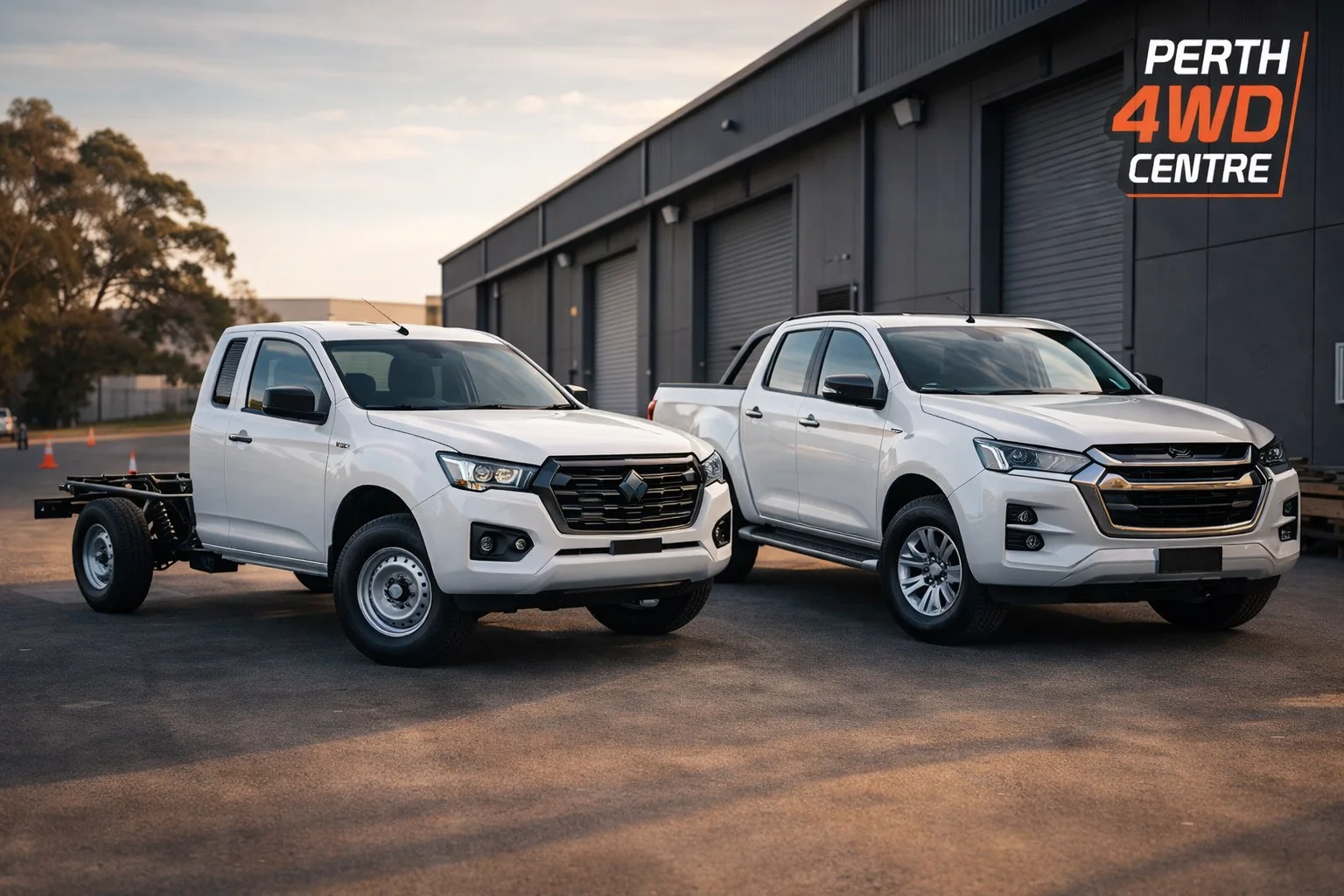
Cab chassis vs ute comes down to one simple question: do you want a vehicle you can build around the job, or one that is ready to drive from day one?
In Perth WA, that choice matters for tradies, business owners and off-road drivers because a cab chassis gives you a customisable base for trays, toolboxes and canopies, while modern utes are now widely used as family cars, daily runabouts and adventure vehicles as well as work vehicles.
Before you decide, ask yourself: are you choosing based on price and looks, or on how the vehicle will actually perform for your work, lifestyle, and long-term needs? That’s where most buyers get it wrong. Thus, understanding the real differences becomes crucial.
In this guide, you will discover the key differences in cost, comfort, towing, customisation and real-world use so you can confidently choose the right option.
So, let’s find out which setup truly works for your needs in Perth conditions.
What Is a Cab Chassis?
A cab chassis is a vehicle built with the cabin at the front and a bare chassis at the back, with the rear body left open so it can be fitted to the job you need.
In Australia, this usually means the tray is sold separately, which gives owners more freedom to choose a steel tray, alloy tray, canopy, or other custom setup. This format is commonly used for work-focused vehicles in single-cab and double-cab layouts.
For Perth tradies, fleet owners and builders, that flexibility is the big advantage. A cab chassis is the better choice when you need a vehicle that can be set up for tools, equipment, loads, or trade-specific storage rather than kept in its standard factory form.
Key features of a cab chassis:
- Cabin at the front with an open rear chassis
- Tray fitted separately
- Easy to customise for work or touring
- Commonly used for trades, fleet vehicles, mining and construction
- Available in single-cab and double-cab layouts
Common examples of cab chassis in Australia include the Toyota HiLux Cab-Chassis and LandCruiser 70 Cab-Chassis, and many ute-based platforms such as the Ford Ranger and Isuzu D-MAX are discussed in the same cab/ute comparison space because buyers often choose between the two body styles.
What Is a UTE?
A ute is a utility vehicle with a passenger cabin at the front and a tray or tub at the rear. In Australia, the tray is considered a defining feature of the ute, and vehicles without bodywork behind the cabin are generally classed as cab chassis instead.
Ute tubs as standard on the HiLux and they are integrated into the bodywork, while trays can be added as a separate option.
In simple terms, a ute is the more ready-to-drive option. The rear cargo area is already fitted from the start, so it suits buyers who want convenience, everyday usability and a vehicle that can handle work during the week and lifestyle use on weekends.
Key features of a ute:
- Factory-fitted tub or tray
- Ready to drive from the dealership
- Practical for daily use and light work
- Used for family driving, touring and general transport
- Can still be upgraded with covers, canopies and storage accessories
Additionally, tubs can be fitted with toolboxes, hard tonneau covers and canopies, which makes them practical for tradespeople, campers and anyone who wants extra security or storage without fully rebuilding the rear of the vehicle.
Now that you know what actually cab chassis and Ute are, let’s dig deeper into their pros and cons so that you can pick the right one according to your preferences.
Cab Chassis Pros and Cons: Built for Custom Work in Perth
A cab chassis is the more flexible option when you want the vehicle to be built around the job, not the other way around. Here’s why a cab chassis works so well:
Pros
- Easy to customise: You can fit a steel or alloy tray, toolbox, canopy or another trade-specific setup.
- Better for heavy-duty work: The rear is built for practical load carrying, which makes it useful for trades, fleet use, mining and construction.
- More flexible for business use: The same base vehicle can be set up for tools, materials, storage or touring gear.
- Strong long-term value for work buyers: If your needs change over time, the rear setup can change with them.
Cons
- Not ready to use straight away: You still need to fit the tray or body you want.
- Extra setup cost: The total spend depends on the tray, canopy and accessories you add.
Next, let’s look at the ute, which is the more convenient factory-ready alternative.
UTE Pros and Cons: Factory-Ready Convenience for Work and Life
A ute is the simpler choice when you want a vehicle that is already set up and ready to drive. In Australia, utes are widely used for towing, family use, tradie work and off-road trips. Modern models are designed with more comfort and smarter features than older work-focused utes. Here’s why many buyers choose a ute:
Pros
- Ready to drive: The factory tub or tray is already fitted, so there is less setup work.
- More everyday comfort: Modern utes often feel more car-like inside, which suits daily driving and family use.
- Good all-round versatility: They are a strong choice for mixed use, from school runs to light work and weekend trips.
- Lower initial complexity: You do not need to plan a full tray-and-accessories build straight away.
Cons
- Less customisable than a cab chassis: The rear body is already fixed, so your options are more limited.
- Can cost more upfront: You are paying for the built-in rear setup from the start.
From here, the next step is comparing both setups side by side so you can see which one suits your work, budget and lifestyle best.
Cab Chassis vs UTE: Key Differences Explained
A cab chassis is designed as a customisable platform, while a ute is a ready-to-drive vehicle with a factory-fitted tub. Let’s go through the key differences in detail:
➣ Purpose & Use: Workhorse vs Everyday All-Rounder
A cab chassis is built for purpose-driven work. It’s commonly used by tradies (electricians, plumbers, builders), mining and construction workers, and fleet and commercial operators. Because you can add a tray, canopy, or toolboxes, it becomes a fully tailored work vehicle.
A Ute, on the other hand, is designed as an all-rounder. It suits daily driving, weekend adventures, and light trade or business use.
For Perth drivers balancing work and lifestyle, utes are the “do-it-all” option, while cab chassis setups are the go-to for serious work requirements.
➣ Comfort & Practicality: Work-Focused vs Lifestyle-Friendly
When it comes to comfort, utes generally have the edge. Modern utes offer:
- Car-like interiors
- Advanced safety features
- Smooth ride quality
- Dual-cab seating for up to five passengers
Cab chassis vehicles, while available in dual-cab options, are typically:
- More basic inside
- Built with durability in mind
- Focused on function over comfort
If your vehicle doubles as a family car, a ute is often the better fit. If it’s mainly for work, a cab chassis delivers where it matters.
➣ Payload, Towing & Performance Capabilities
Both cab chassis and utes perform well off-road and under load, especially in 4WD configurations. However, there are key differences.
Cab chassis advantages:
- Higher payload potential (due to custom tray setup)
- Better weight distribution options
- Ideal for carrying tools, machinery, or heavy materials
UTE advantages:
- Strong towing capacity (varies by model)
- Factory suspension tuned for balance
- Reliable for towing caravans or trailers
In demanding WA environments like construction sites or remote areas, cab chassis setups often perform better for heavy-duty applications, while utes handle general towing and off-road use comfortably.
➣ Customisation & Accessories: Flexibility vs Convenience
This is where the biggest difference lies.
A cab chassis gives you complete control:
- Steel or aluminium trays
- Toolboxes and under-tray storage
- Canopies for secure storage
- Custom builds for trade or touring
A UTE offers limited but practical upgrades:
- Tonneau covers
- Tub liners
- Basic canopies
- Drawer systems
If you need a vehicle tailored to your job or lifestyle, cab chassis wins. If you prefer something ready-made with minimal setup, a ute is the easier choice.
➣ Price & Cost Differences: Upfront vs Long-Term Value
At first glance, a cab chassis may seem cheaper, but the total cost depends on your setup.
Cab Chassis Costs:
- Lower base vehicle price
- Additional cost for tray ($3,000–$10,000+)
- Extra for canopies, toolboxes, accessories
UTE Costs:
- Higher upfront price (includes tub)
- Minimal setup costs
- Fewer immediate upgrades needed
For Perth tradies and businesses, a cab chassis delivers better long-term value because it’s built exactly for the job. For personal use, a ute offers simplicity and predictable costs.
Quick Comparison: Cab Chassis vs UTE
| Feature | Cab Chassis | UTE |
| Rear Setup | No tray (custom fit) | Factory tub included |
| Flexibility | Fully customisable | Limited to factory design |
| Best For | Tradies, fleets, heavy-duty work | Lifestyle, daily driving |
| Comfort | Basic, work-focused | More refined, car-like |
| Payload & Towing | Higher potential capacity | Slightly lower (varies by model) |
| Upfront Cost | Lower base price | Higher upfront (includes tub) |
| Total Cost | Depends on setup | More predictable |
In short: cab chassis = flexibility, UTE = convenience.
Key Takeaway
- Choose a cab chassis if you need flexibility, heavy-duty capability, and a work-ready setup.
- Choose a UTE if you want comfort, convenience, and a vehicle ready to drive from day one.
Cab Chassis vs UTE Cost in Australia
When comparing cab chassis and ute cost in Australia, the key difference is not just the purchase price but the total cost of ownership. In Perth WA, where vehicles are used for trade, off-road work and long-distance driving, it is important to understand both the upfront and ongoing costs.
Upfront Utility Vehicle Cost in Perth:
- UTE (factory tub included): Typically ranges from $40,000 to $70,000+, depending on the model and features. The higher upfront price includes a factory-fitted tub, making it ready to drive immediately.
- Cab chassis (no tray included): Usually priced slightly lower or similar at the base level. However, it comes without a rear tray, which must be added separately.
Additional Setup Costs for Cab Chassis
A cab chassis requires additional investment to become fully functional. Common costs include:
- Steel or alloy tray: $3,000 – $10,000+
- Canopy systems: $5,000 – $15,000+
- Toolboxes and storage: $1,000 – $5,000+
These costs vary depending on materials, build quality and level of customisation.
Long-Term Value and ROI
- Cab chassis offers better long-term value for tradies and businesses. It can be customised to suit specific work requirements and adapted over time.
- UTE provides predictable costs and is easier to manage upfront. It is often preferred for personal use and tends to have strong resale demand in Australia.
Ultimately, cab chassis is ideal if you want a vehicle tailored to your work and are prepared for additional setup costs. Ute is ideal if you want a straightforward, ready-to-use vehicle with fewer upfront decisions.
How to Choose Between a Cab Chassis and a UTE
Choosing between a cab chassis and a ute comes down to asking the right questions:
| Question | Choose Cab Chassis If… | Choose UTE If… |
| What is the primary purpose of the vehicle? | You need it for work, tools, or heavy loads | You want a mix of work and daily driving |
| What is your budget now and long term? | You’re willing to invest more over time for setup | You prefer a fixed, upfront cost with no setup |
| How many passengers will you carry? | Mainly for work crew or occasional use | Regular family use and daily commuting |
| Do you want customisation or convenience? | You need trays, canopies, or toolboxes | You want a ready-to-drive vehicle |
| Will you upgrade or modify it later? | You plan to add or change your setup | You want minimal or no modifications |
Quick Decision
- Choose a cab chassis if your vehicle is primarily a work tool.
- Choose a UTE if you need a balance between work and lifestyle.
Conclusion: Which Should You Choose – Cab Chassis or UTE?
Choosing between a cab chassis and a ute comes down to your lifestyle, work requirements and long-term plans.
Choose a cab chassis if:
- You need a customised vehicle for work
- You regularly carry tools or heavy equipment
- You work in trades, construction or mining
- You plan to modify or upgrade your setup
Cab chassis vehicles are a popular choice for Perth tradies because they can be tailored to suit demanding work conditions.
Choose a ute if:
- You want a ready-to-drive vehicle
- You need comfort for daily use and family driving
- You require light-duty work capability
- You prefer simplicity with minimal setup
Cab chassis vehicles are best suited for heavy-duty work and flexibility, while utes are better for comfort, convenience and everyday use.
Still not sure which setup will actually work for your needs?
Get the Right Cab Chassis or Ute Setup for Your Work and Lifestyle at Perth 4WD
At Perth 4WD, we help you go beyond the basic choice. Whether you need a fully customised cab chassis with a heavy-duty tray, or a ready-to-go ute with the right accessories, our team can guide you to the best solution based on how you actually use your vehicle.
From steel trays and canopies to quality 4WD parts and accessories, everything is designed to match your work requirements, budget and future plans.
FAQs
- What is the main difference between a cab chassis and a UTE?
A cab chassis has no rear tray and is designed for custom setups, while a ute comes with a factory-fitted tub and is ready to drive immediately.
- Is a cab chassis better for tradies?
Yes. A cab chassis is better for tradies because it allows full customisation with trays, toolboxes and canopies, making it more practical for carrying tools and equipment.
- Can I customise a UTE like a cab chassis?
Yes. You can add accessories like toolboxes, covers or canopies. But a ute is still limited by its factory tub, whereas a cab chassis offers much greater flexibility.
- Can I convert a cab chassis into a Ute?
Yes, but it requires installing a tub or rear body, which can be expensive and may not match the finish of a factory-built ute.
- Is a UTE cheaper than a cab chassis?
A ute is usually more expensive upfront because it includes a tub, while a cab chassis may start cheaper but requires additional spending on trays and accessories, which can increase the total cost.
- Which vehicle is more fuel-efficient?
Fuel efficiency depends on the model, engine and setup. Lighter cab chassis vehicles without heavy accessories may use slightly less fuel, but overall differences are usually minimal.
- Which vehicle holds its value better?
Dual-cab utes generally hold value better due to high demand in both private and commercial markets. However, well-maintained cab chassis vehicles with quality setups also retain strong value in trade industries.
- Which is better for off-road driving – cab chassis or UTE?
Both perform well off-road depending on the model and setup. Utes offer comfort and factory tuning, while cab chassis vehicles can be customised for more demanding off-road and touring conditions.